What is Lewis Harrison about?
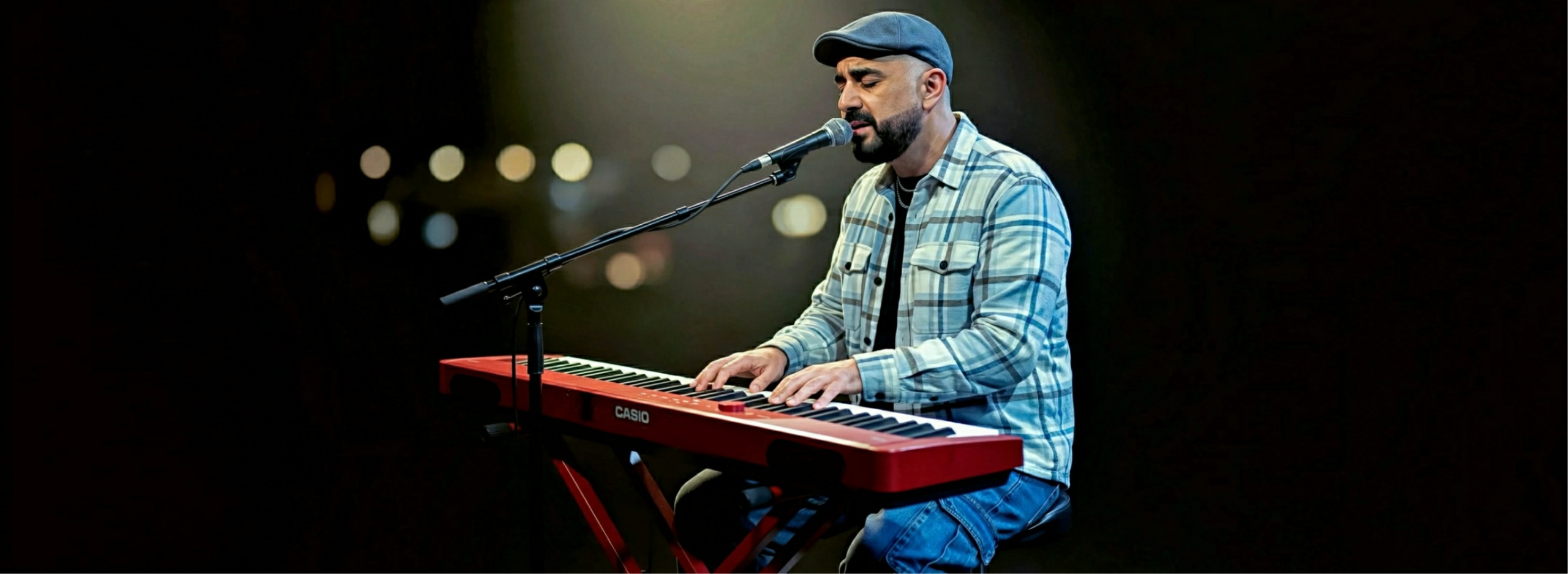
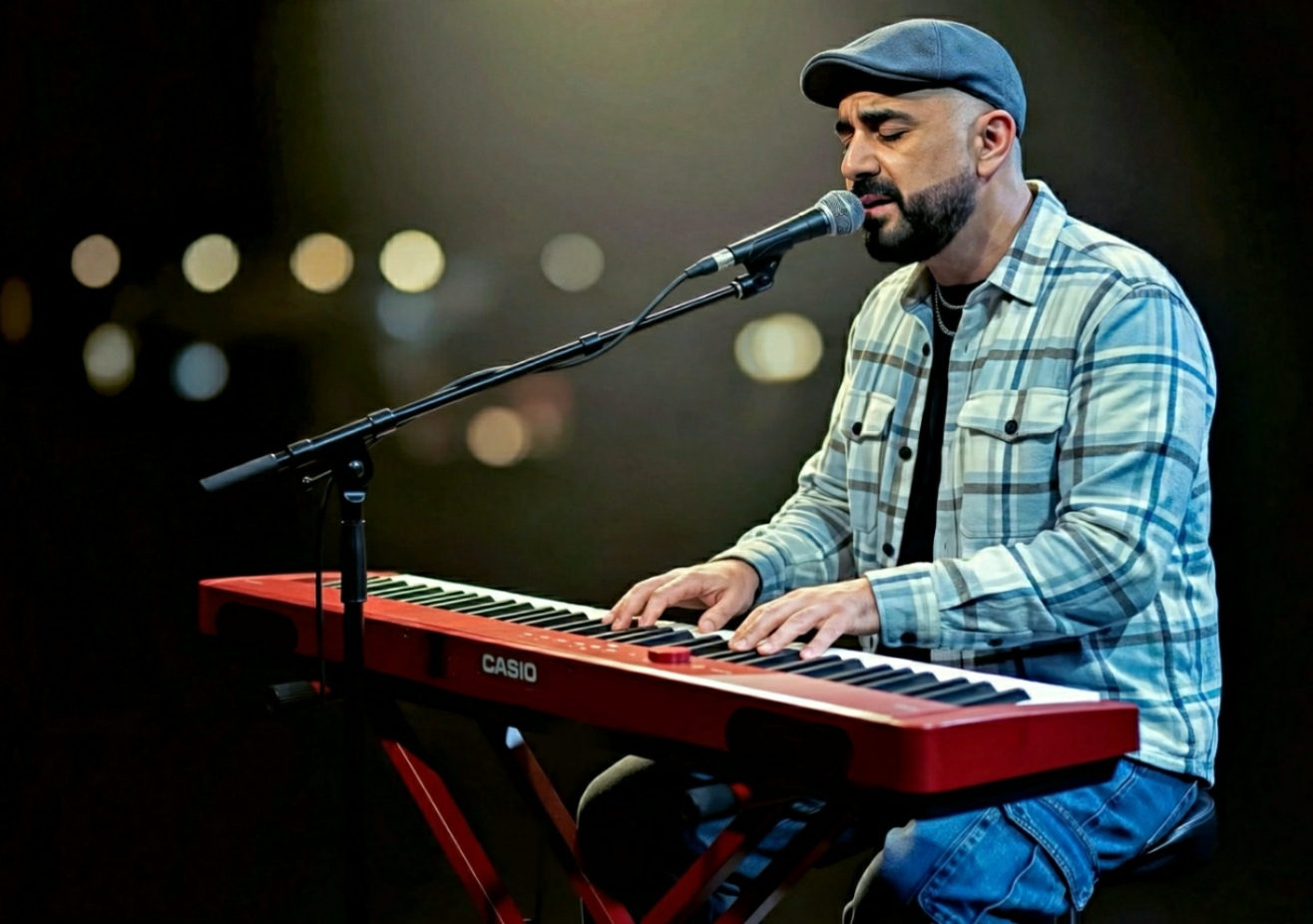
The musical style that I create when I'm being Lewis, is a kind of jazz—not typical modern jazz, not jazz funk or smooth jazz, but a contemporary yet nostalgic/timeless sound of my own. I enjoy making intricate, complex harmonies and rhythms, often impressionistic but in a way that is expressively clear, so that they never really sound strange or self-consciously "modern". The melodies and textures that appear tend to "speak" in rather subtle, deep ways but I often allow a beautiful, tuneful exuberance to emerge. The production is minimal with solo piano – either acoustic or electric – forming almost the entire arrangement. I record simple beats on a cajon to frame the piano and sharpen the groove. I sometimes also sing in a soulful style, but the piano is always the main storyteller.
I have the ability to "speak" the language of music spontaneously and directly—a skill I love to use in my live shows, to create a kind of musical stand-up or conversational approach, alongside rehearsed performances. In my recordings too, I lean more towards an unedited, improvisatory process, and resist using technology to perfect the material performance. In a world where music is often more of a packaged product, and now with the advent of generative AI, I want my musical expression to be as real and embodied as possible, communicating naturally with a kind of unflitered immediacy, connected through the body to the soul. This way, I can avoid the trap of contriving results that might be considered cool or impressive, and simply express raw feelings in a kind of flow state.
I grew up in the competitive world of classical piano, which wasn't a good fit for me in many ways—although I do love the music and still make and share classical(-ish) music, as Phil Best – my birth name. For so many years, I kept my soulful jazz under wraps—I played it as a kind of rebellion just for myself. The decision to share it publicly is something of a tribute to my wonderful Grandma, Louise Harrison. We had a wonderful connection when I was growing up. She didn't share the snobbishness about music that my parents and teachers often showed. Instead, she encouraged me to use music as a way of telling my inner stories, as something healing and deep, without any trace of pretentiousness.
Music – the language of feeling
In our culture, music is often more decorative, atmospheric or mood-enhancing, something that sits behind the narrative of song lyrics or a the drama of a film. For me, music is a language and can tell meaningful, magical stories of its own—it has the power to do something quite remarkable like unlock the wisdom of the soul or connect with a higher consciousness. Words express so much but they can sometimes struggle to impart the deeper feelings that music uncovers with such depth and ease. As the language of feeling, music is honest in an uncensored way, whereas words tend towards being more descriptive, politic or argumentative. Music simply expresses directly, without the need to convince, protest, manipulate or reason. It fascinates me how much compassion and truth can be contained in a few musical shapes—it feels quite mysterious how we can understand its messages independent from rational thought.
When I play my own soulful jazz, it's a personal celebration of the human spirit, and also a means of connecting with inner courage and wonder to keep me curious about my inner world. The music is always seeking answers to the questions posed by life – especially its uncertainty, confusion and suffering. Whether the music sounds cool or clever is not important to me. At the risk of sounding sentimental, what interests me most is finding the path of love—by allowing the groove to unfold naturally with a kind of effortless musical storytelling, full of compassion and truth.
A way to make sense of life
So I seek a kind of warmth, candour, introspection and sense of "telling the truth" in my improvisations, songs and pieces. People often tell me there's a film-music quality to it and whilst I like how this points to storytelling and drama, it's not quite what I'm doing. Film music works to generate a mood or perhaps the internal feeling sense of a character. What I'm really looking for is more personal and pointed—I'm trying to give clear expression to the inward experience of being alive in the world, to process it, to tell about it moment by moment, to work through it in all its joy or pain. Music helps me deal with life. It's the unfolding dialogue, the action, not a background narration.
There's a kind of chatty element to my music, as I engage in a soulful examinations of life, seeking something genuinely consoling, encouraging, relieving, revitalising. Soulfulness in music is one of those things that is often talked about but is not easy to define. I think it emerges when the language of music processes life's complexities with real compassion and a desire for empowerment. And this really motivates me to share my music—I love the idea that it might speak to people directly, with intensity, clarity and an optimistic spirit.
The jazzy musical voice that I use here might often seem impressionistic or lush but it has a certain precision. A harmonic shift, a rhythmic figure, a melodic phrase might seem to be vague in their meaning – and of course, there is none of the literal meaning that words impart – but I intend each musical shape that I "say" to mean something distinct and specific, whether it appears inside crisp, clean textures or impressionistic, dreamy ones.
Pianos, both in their acoustic and electric forms have tremendous scope as instruments to generate a complex, varied palette of sounds. I love them for this and also because they feel like an extension of my body and soul. The patterns that my fingers trace over the keys come from somewhere deep with, somewhere honest and vulnerable. The earthy, simple sound of cajon beats, frames the piano and sometimes my singing, to create a feeling of groove—that compelling vibe or energy that evokes poetry or grace and reveals or explains what words alone never do.
Yet the groove can also provide me with a kind of cool logic. In its clear unfolding structure, I'm searching for a certain kind of lucidity—a musically-induced sanity that comes from its disarming openness and truth. Like a kind of therapy, I love how music can disclose the subtleties of the human soul in sharp detail. And my wish is that as I use this tool for my own inward examination, my listeners might get to uncover things within themselves.